
How to Play Subway Surfers
Subway Surfers is an endless runner where your character automatically moves forward while you avoid trains, barriers, and other obstacles, collect coins, and try to keep the run going for as long as possible. The basic controls are simple: move between lanes, jump over obstacles, roll under hazards, and use a hoverboard when you need extra protection. On touchscreen devices, these actions are performed with swipes, while browser and PC versions can use keyboard controls depending on the platform.
The main goal is not to reach a finish line but to survive, collect useful items, and build your score as the run becomes faster. Beginners should first focus on learning the movement controls and recognizing common obstacle patterns instead of trying to collect every coin. Once the basic movements become natural, you can start improving your multiplier, using power-ups more effectively, and taking longer runs with fewer mistakes.
How to Play Subway Surfers: First Run
Your first Subway Surfers run is mainly about learning the controls and understanding how the character reacts to each movement. The game starts with your character running automatically, so you can concentrate on changing lanes, jumping, rolling, and avoiding obstacles rather than controlling forward movement yourself.
- Start the run: Let the character move forward automatically and focus on the track ahead.
- Move between lanes: Swipe left or right to change lanes and avoid trains or other obstacles.
- Jump over obstacles: Swipe upward when you need to clear a barrier or another obstacle.
- Roll under hazards: Swipe downward to roll beneath suitable obstacles.
- Collect coins when safe: Pick up coins when they are on a safe path, but do not crash while trying to collect them.
- Learn the track: Watch the upcoming section instead of focusing only on what is immediately in front of your character.
- Use the hoverboard when appropriate: A hoverboard can provide extra protection during a run, making it useful when you want to reduce the risk of losing a good attempt.
- Focus on survival first: During your first few runs, learning movement and avoiding crashes is more important than chasing a very high score.
After a few attempts, the controls should start feeling more natural. Once you can reliably switch lanes, jump, and roll without hesitation, you can begin paying more attention to coins, power-ups, score multipliers, and longer runs.
Movement Controls and Swipe Actions
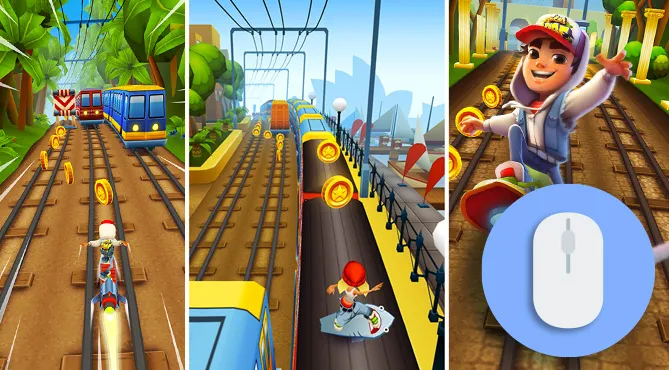
Subway Surfers uses simple swipe controls to handle the character’s main movements. Because the character runs forward automatically, your attention is mainly on choosing the correct lane and timing each jump or roll. Learning these basic actions should be your first priority before trying to maximize coins or score.
| Action | Swipe | What It Does | Best Used For |
|---|---|---|---|
| Move Left | Swipe left | Moves the character to the left lane | Avoiding trains or changing position |
| Move Right | Swipe right | Moves the character to the right lane | Avoiding obstacles or reaching a safer lane |
| Jump | Swipe up | Makes the character jump | Clearing barriers, trains, and low obstacles |
| Roll | Swipe down | Makes the character roll | Passing underneath suitable overhead obstacles |
| Hoverboard | Double-tap | Activates a hoverboard when available | Adding protection during a run |
The key is timing rather than speed. A quick swipe is not always the best movement if the next lane contains another obstacle. Look slightly ahead on the track and decide where you want to land before making the movement. With practice, lane changes, jumps, and rolls become reactions instead of movements you have to consciously think about.
On touchscreen devices, these swipe actions form the core control system. If you are playing through a browser or another platform, the available keyboard or controller controls can differ, so check the controls provided by that version rather than assuming every setup uses the same inputs.
Trains, Barriers, and Track Hazards

Subway Surfers places different hazards on the track to test your timing and lane control. Trains can block a lane or move toward your path, while barriers and other track obstacles require you to switch lanes, jump, or roll at the right moment. Learning to identify the type of hazard before you reach it is one of the most important skills for maintaining a longer run.
| Hazard | What to Watch For | Usual Response | Beginner Tip |
|---|---|---|---|
| Stationary train | A train blocking your current lane | Move to another lane or jump when appropriate | Look for an open lane before getting too close |
| Moving train | A train approaching or crossing your path | Change lanes or use a suitable jump | React early instead of waiting until the last moment |
| Low barrier | A barrier positioned across the track | Jump over it | Start the jump with enough distance to clear it |
| Overhead obstacle | An obstacle that requires you to pass underneath | Roll underneath when possible | Avoid jumping into an overhead hazard |
| Multiple obstacles | Several hazards occupying nearby lanes | Choose the safest available route | Look ahead and plan the next movement |
| Track gap or difficult section | A section requiring precise movement | Use the appropriate movement or route | Avoid sudden swipes when the path is unclear |
The safest approach is to look ahead and plan your movement before reaching the hazard. Trying to react at the last possible second makes mistakes more likely, especially as the running speed increases. You also do not need to collect every coin if doing so forces you into a dangerous lane.
For beginners, survival should come before aggressive collecting. Once you become familiar with the common obstacle patterns, you can start combining lane changes, jumps, and rolls more smoothly to maintain longer runs.
Building a Reliable Run Routine

- Start with a simple goal: Focus on completing a clean run rather than immediately chasing a personal-best score.
- Warm up your controls: Spend a few runs practicing lane changes, jumps, and rolls so your movements feel natural.
- Look ahead: Keep your attention on upcoming trains, barriers, and track patterns instead of reacting only to the nearest obstacle.
- Prioritize safe routes: Skip a coin or power-up when collecting it would put the entire run at unnecessary risk.
- Maintain your multiplier: Once you have a useful multiplier, avoid careless crashes that can end a strong attempt.
- Use power-ups deliberately: Use available power-ups when they provide a clear advantage instead of activating them without a reason.
- Keep movements controlled: Avoid repeated or unnecessary swipes when your current lane is already safe.
- Practice difficult patterns separately: If one type of obstacle repeatedly causes crashes, focus on improving that movement during shorter practice runs.
- Stay consistent as speed increases: As the game becomes faster, rely on anticipation and familiar movement patterns instead of rushing your reactions.
- Review what ended the run: After a crash, identify whether the problem was timing, lane choice, hesitation, or an unnecessary risk, then focus on that issue in the next attempt.
A reliable routine is more useful than trying a different trick on every run. The aim is to make basic movements automatic, recognize hazards earlier, and gradually extend the amount of time you can stay in control. Once that foundation is consistent, improving your score becomes much more manageable.
Common Beginner Mistakes
- Trying to collect every coin: Beginners often move into dangerous lanes just to grab a few extra coins. If the route is unsafe, staying alive is usually the better choice.
- Reacting too late: Waiting until a train or barrier is almost directly in front of you leaves very little time to make the correct movement.
- Looking only at the nearest obstacle: Focusing on what is immediately ahead can make you miss the next obstacle or a safer lane further along the track.
- Using too many swipes: Unnecessary lane changes can move you directly into another hazard. Make each movement with a clear purpose.
- Jumping without checking what comes next: Clearing one obstacle does not always mean the landing area is safe. Look ahead before committing to a jump.
- Ignoring the roll: Some hazards are designed to be passed underneath, so relying only on lane changes and jumps can lead to avoidable crashes.
- Taking unnecessary risks for power-ups: A power-up is useful only if you can collect it safely. Do not sacrifice an otherwise strong run for one item.
- Chasing a high score too early: Beginners may try to maximize points before they are comfortable with the controls. Building consistency first makes longer runs easier.
- Panicking when the speed increases: Faster gameplay requires earlier decisions, not random movements. Staying calm helps you recognize patterns and react accurately.
- Repeating the same mistake: Starting another run without considering what caused the previous crash makes improvement slower. Identify the mistake and deliberately practice that situation.
Most beginner mistakes come from poor timing, overreaction, or focusing too narrowly on immediate rewards. A better approach is to look ahead, choose a survivable route, and make deliberate movements. Once avoiding common hazards becomes automatic, you can pay more attention to score, coins, power-ups, and longer runs.
FAQ
Final Thoughts
Learning how to play Subway Surfers is mostly about mastering movement, recognizing hazards early, and building consistent runs. You do not need advanced techniques to get started. Focus first on lane changes, jumps, rolls, and understanding when it is safer to ignore a coin or power-up rather than risk a crash.
As your controls become more natural, you can improve your runs by anticipating obstacles, choosing safer routes, using hoverboards and power-ups strategically, and maintaining concentration as the game speeds up. The biggest improvement usually comes from practice and learning from mistakes rather than trying to use a different trick every time.
A controlled and consistent run is a better foundation than taking unnecessary risks, both for casual play and for working toward a higher score. Once the basics become automatic, longer runs and better scores become much easier to achieve.